
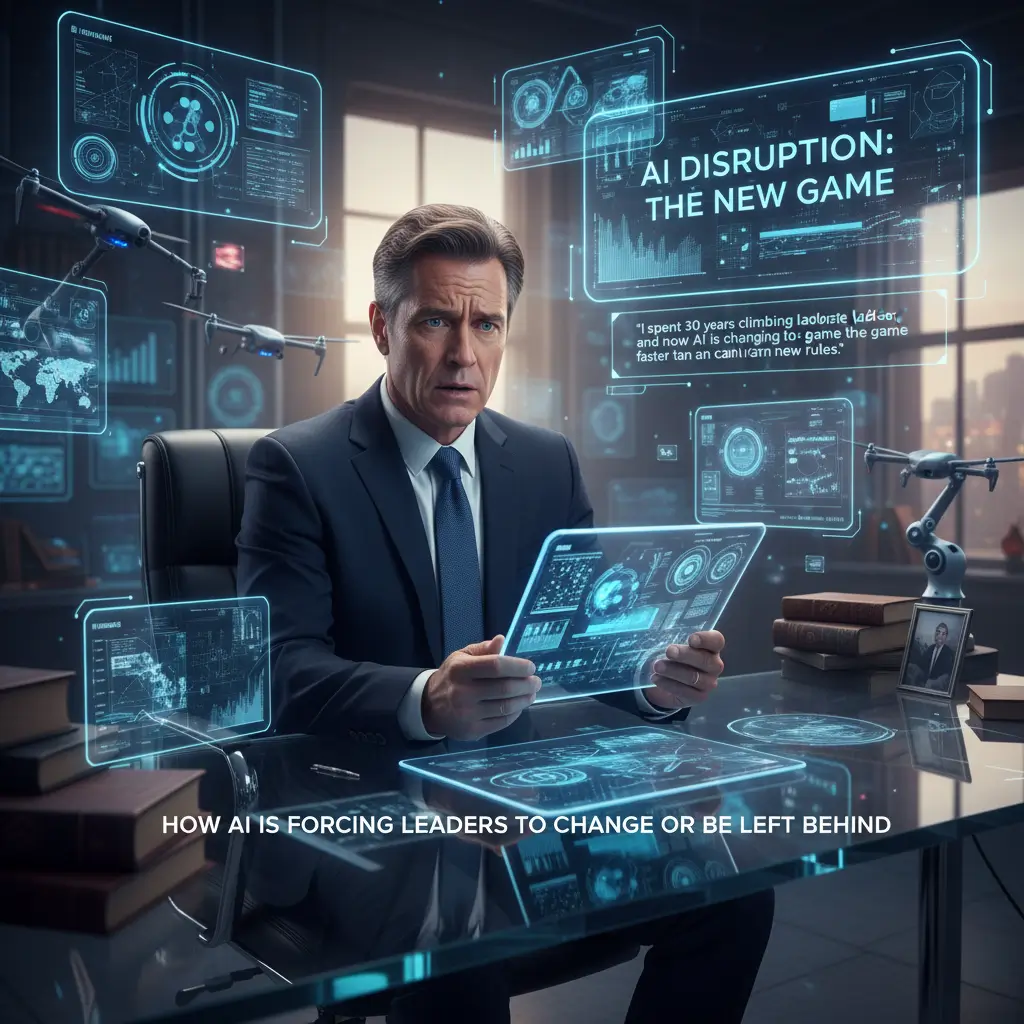
The CEO of a Fortune 500 company recently told me something that stopped me cold: “I spent 30 years climbing the corporate ladder, and now AI is changing the game faster than I can learn the new rules.”
He’s not alone. Every leader I’ve spoken with in the past year shares the same underlying anxiety adapt to AI or become irrelevant.
The harsh reality? They’re right to be worried.
The AI Revolution Is not Coming It’s Already Here
We’re past the point of debating whether AI will transform leadership. The transformation is happening right now, in real-time, across every industry.
Consider this: 75% of C-suite executives believe their company will significantly increase AI investments over the next three years. But here’s the kicker less than 20% feel confident in their ability to lead through this change.
That gap between intention and capability? That’s where careers are made or broken.
The Old Leadership Playbook Is Dead
Traditional leadership relied on experience, intuition, and human judgment. You climbed the ranks by knowing your industry inside out, making smart calls based on past patterns, and managing people effectively.
AI doesn’t care about your 20 years of experience if you can’t adapt to data-driven decision making.
Machine learning algorithms can now predict market trends better than seasoned executives. Natural language processing tools can analyze customer sentiment faster than any focus group. Automation is handling tasks that once required entire departments.
So what happens to leaders who built their careers on now-obsolete skills?
They have two choices: evolve or exit.
The Five Ways AI Is Rewriting Leadership Rules
1. Decision-Making Is Now Data-First, Gut-Second
Remember when leaders could make million-dollar decisions based on instinct? Those days are numbered.
AI-powered analytics provide insights that human intuition simply can’t match. Leaders who ignore data in favor of “gut feelings” are increasingly finding themselves on the wrong side of outcomes.
But here’s the nuance it’s not about replacing human judgment entirely. It’s about using AI to inform and enhance decision-making. The best leaders are learning to blend machine intelligence with human wisdom.
2. The Speed of Business Has Hit Warp Drive
AI operates at machine speed. Competitors using AI can analyze markets, adjust strategies, and implement changes before traditional leaders finish their morning coffee.
A retail executive recently shared how their AI-powered competitor could adjust pricing across thousands of products in real-time based on demand signals. Meanwhile, his company still held weekly pricing meetings.
Guess who’s winning that battle?
3. The Workforce Expects AI-Savvy Leadership
How is AI changing leadership roles? It’s fundamentally altering what employees expect from their leaders.
Today’s workforce, especially younger generations, expects leaders who understand AI’s potential and limitations. They want bosses who can guide them through automation anxiety, not leaders who pretend AI doesn’t exist.
Employees are looking for leaders who can answer tough questions: Will AI take my job? How do I stay relevant? What skills should I develop?
Leaders who can’t address these concerns credibly lose respect and influence fast.
4. Innovation Cycles Have Collapsed
Product development that once took years now happens in months. Marketing campaigns that required weeks of planning can be generated and tested in hours.
AI accelerates every aspect of innovation. Leaders stuck in quarterly planning cycles are being outmaneuvered by competitors who iterate daily using AI-driven insights.
5. The Competitive Landscape Is Ruthlessly Darwinian
AI doesn’t just level the playing field—it creates entirely new games.
Startups with AI at their core are disrupting established industries overnight. Traditional companies without AI strategies are watching their market share evaporate.
The message is clear: adapt or die isn’t hyperbole anymore. It’s business reality.
The Skills Modern Leaders Must Master (Or Fake It Till They Make It)
What skills do leaders need in the AI era? The answer might surprise you.
It’s not about becoming a data scientist or learning to code (though basic technical literacy helps). It’s about developing a new leadership mindset.
Digital Fluency Over Digital Mastery
You don’t need to understand the mathematical intricacies of neural networks. But you do need to grasp what AI can and cannot do for your business.
Think of it like driving a car. You don’t need to be a mechanic, but you should understand basic operations and limitations.
Strategic Vision in an Uncertain World
AI makes prediction easier but planning harder. Why? Because the pace of change keeps accelerating.
Modern leaders need to develop what I call “adaptive strategy”—the ability to set direction while remaining flexible enough to pivot when AI reveals new opportunities or threats.
Ethical Navigation
AI raises thorny ethical questions. Bias in algorithms. Privacy concerns. Job displacement.
Leaders can’t punt these issues to the tech team. They need to engage directly with the ethical implications of AI deployment.
Human-Centric Leadership
Ironically, as businesses become more automated, human skills become more valuable.
Empathy, creativity, and emotional intelligence—these uniquely human capabilities become competitive advantages in an AI-saturated world.
The Brutal Mistakes Leaders Make With AI
Let me be blunt about the ways leaders shoot themselves in the foot with AI.
Mistake #1: The “Wait and See” Approach
Some leaders think they can wait until AI “proves itself” before investing. By then, their competitors have already captured the advantage.
Waiting for perfect clarity in the AI revolution is like waiting for the storm to pass while your ship is sinking.
Mistake #2: The Technology-First Fallacy
Others make the opposite error throwing money at AI without clear strategy.
Buying expensive AI tools without understanding how they fit your business model is like buying a Ferrari for your daily commute through Manhattan. Impressive, but ultimately useless.
Mistake #3: Ignoring the Human Factor
Will AI replace human leaders? No, but leaders who ignore the human side of AI transformation will replace themselves through failure.
AI transformation isn’t just about technology—it’s about people. Leaders who forget this find themselves managing rebellions, not transitions.
Mistake #4: The Expertise Trap
Seasoned leaders often assume their deep industry knowledge makes them immune to AI disruption.
Wrong. AI doesn’t respect tenure. In fact, long experience can become a liability if it makes you resistant to new approaches.
You Must Reas

The Step-by-Step Blueprint to Launch Microlearning for Gen Z Teams 2025

The Startup Growth Secret: How Corporate Training Makes the Difference
Real Leaders, Real AI Transformations
Let’s move from theory to practice with examples of leaders navigating the AI revolution.
The Adaptive CEO
Satya Nadella didn’t just add AI to Microsoft’s product line—he rebuilt the company’s entire culture around AI and cloud computing.
The result? Microsoft’s market value increased by over $2 trillion under his leadership.
The lesson? Successful AI transformation starts at the top and permeates every level of the organization.
The Learning Executive
A CPG industry executive I know went from AI skeptic to champion in 18 months. How? She dedicated two hours weekly to understanding AI applications in her industry.
She didn’t become a technical expert. She became conversant enough to ask the right questions and make informed decisions.
Her company now uses AI for demand forecasting, reducing inventory costs by 30%.
The Human-First Leader
The CEO of a major retailer facing automation pressure took an unexpected approach. Instead of hiding behind corporate speak, she openly discussed AI’s impact on jobs.
She implemented reskilling programs before deploying automation. She guaranteed that no one would lose their job to AI without being offered training for new roles.
Result? Employee engagement increased during a period that typically triggers fear and resistance.
Answering the Hard Questions
How can leaders prepare for AI disruption? Start with honest self-assessment.
What aspects of your role could AI enhance or replace? Where does human judgment remain irreplaceable? Build your strategy from these insights.
What are the biggest AI challenges for leaders? Three stand out consistently:
First, the pace of change. AI evolves faster than most organizations can adapt.
Second, the talent gap. Finding people who understand both AI and your business is incredibly difficult.
Third, cultural resistance. Humans naturally resist change, especially when that change threatens their livelihood.
The Uncomfortable Truth About AI and Leadership
Here’s what nobody wants to say out loud: Some leaders won’t make the transition.
Not because they lack intelligence or experience, but because they can’t unlearn old models fast enough to embrace new ones.
The leaders who will thrive share common characteristics:
- Intellectual humility to admit what they don’t know
- Curiosity to continuously learn
- Courage to make decisions with incomplete information
- Empathy to guide people through uncertainty
Building Your AI Leadership Strategy
Stop thinking about AI as a technology challenge. Start thinking about it as a leadership evolution.
Phase 1: Education and Awareness
Dedicate time weekly to understanding AI developments in your industry. Read case studies. Attend workshops. Talk to experts.
But don’t just focus on success stories. Study failures too. Understanding why AI initiatives fail is often more valuable than knowing why they succeed.
Phase 2: Experimentation
Start small. Identify one process or decision area where AI could add value. Run a pilot program.
The goal isn’t immediate transformation. It’s learning what works for your specific context.
Phase 3: Strategic Integration
Once you understand AI’s potential and limitations, develop a comprehensive strategy.
This isn’t about using AI everywhere. It’s about using AI where it makes sense for your business model and values.
Phase 4: Cultural Transformation
Technology is easy. Changing culture is hard.
Successful AI integration requires shifting mindsets, developing new skills, and often restructuring entire departments.
Leaders who underestimate this human element inevitably fail.
The Future Belongs to Hybrid Leaders
The leaders who will dominate the next decade won’t be pure technologists or traditional executives.
They’ll be hybrids leaders who combine human insight with machine intelligence, who balance efficiency with empathy, who embrace change while providing stability.
These leaders understand that AI isn’t about replacing human judgment but augmenting it.
Your Choice: Pioneer or Casualty
The AI revolution offers no middle ground. You’re either actively adapting or gradually becoming obsolete.
Every day you delay is a day your competitors gain advantage. Every decision to “wait and see” is a decision to fall behind.
But here’s the opportunity: We’re still early in this transformation. The leaders who act now—who embrace AI while maintaining their humanity—will define the next era of business.
The question isn’t whether AI will change leadership. It’s whether you’ll lead that change or be swept away by it.
Taking Action in an AI World
Start tomorrow with one simple step: Have an honest conversation with your team about AI.
Ask them what they fear. What they hope. What they need from you as their leader.
Then commit to learning alongside them. Because in the AI era, the most powerful phrase a leader can say isn’t “I know.”
It’s “Let’s figure this out together.”
The leaders who recognize this who combine technological adaptation with human connection won’t just survive the AI revolution.
